I told them exactly what I wanted. It changed nothing.
By Jonas Astrup Beck · September 2026
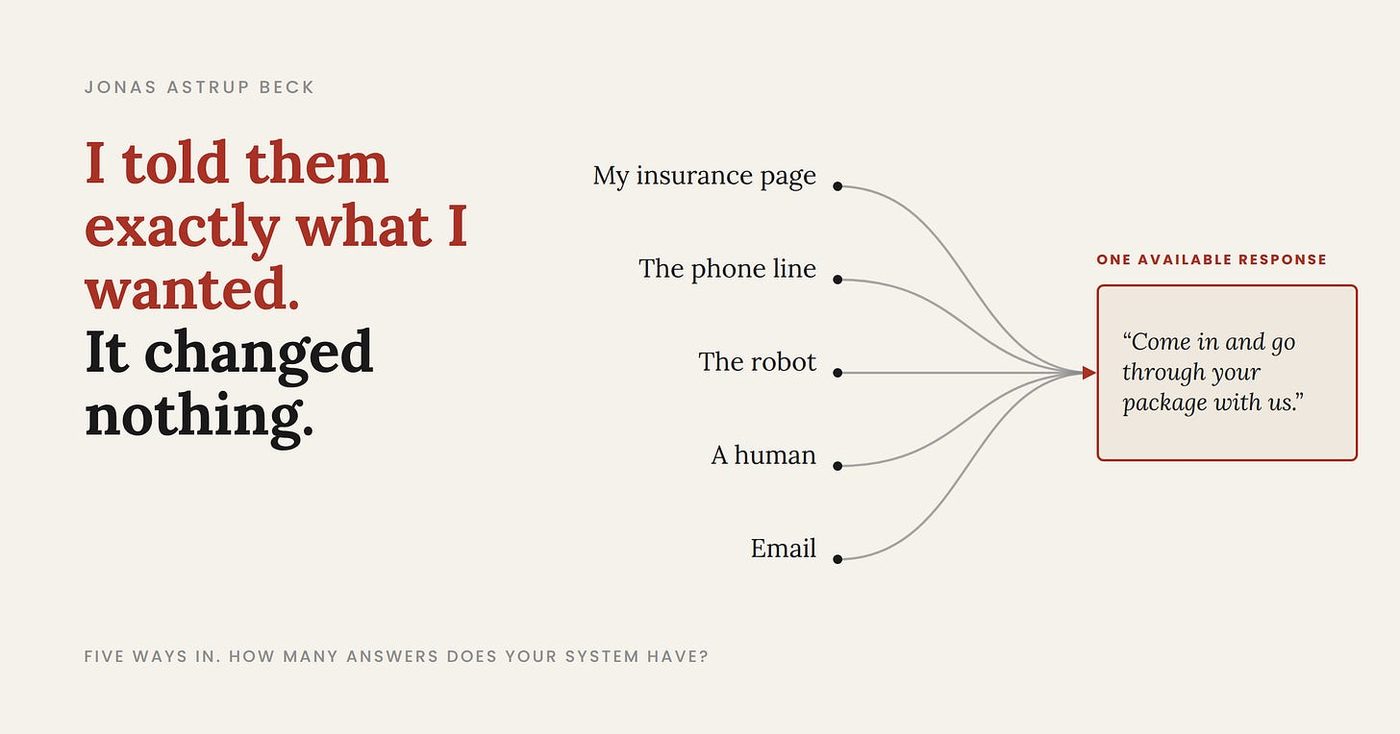
I called my insurer with one request. Look at my whole package, keep the cover exactly as it is, and tell me whether you can give me a better price. Then call me back and we can talk about what you found.
I asked because my car premium had gone up by almost 40 per cent in two years. No claims in more than five. They had reviewed my package themselves three times in that period and decided each time, without me, that I should pay more.
Notice what I did not ask for. I did not ask for a discount, even though nothing had changed on my side and that was the obvious thing to ask for. I asked them to look, and then to talk to me about what they had found.
It took three minutes to find a phone number on their website. Then a robot that could not help me. Then the wrong department, corporate insurance, where the advisor could only talk to me about two small business policies I hold with them.
She understood every word I said. She could not do the review herself, and she was not able to ask anyone else to do it either. What she could offer was to pass me to a colleague who would go through my whole package with me over the phone and check whether I had the right cover.
That is not what I asked for. I asked them to look first.
The only way forward was for me to email the same request in writing, and they would offer me a conversation where I go through my package with them.
I had told them exactly what I wanted and explained why I wanted it. It changed nothing.
THEY ALREADY KNOW HOW TO DO THIS
When you look at it from the outside, it does feel kind of skewed.
They had already reviewed my package. Three times. Nobody asked them to, nobody sat in a meeting with them, and I found out the result on my bank statement or a standard email with a standard explanation.
So the capability exists. It runs on its own. It just runs in one direction.
They will study my account when the answer might be more money, and offer me a meeting when the answer might be less.
I think this is deliberate. Someone decided how prices move, and the reason is not hard to see. What nobody seems to have anticipated is the same method pointed back the other way, a customer asking them to do to their own pricing what they had already done to mine three times without asking me.
If it feels unreasonable from the receiving end, it usually is. And the only reason I picked up the phone at all was that they did it first.
WHAT THE TECHNOLOGY WAS ACTUALLY FOR
There was plenty of technology in this. There is a login-protected page where I can see my insurance package and make certain changes myself. And there was the robot that met me at the front door and asked me to explain myself, which was supposed to help me. It felt more like it was there to keep me away from a person, and for a while it did.
I also suspect something automated reviewed my package and moved my price. I do not know that for sure of course, but I do know the industry. Nobody told me, and nobody has to. It is worth sitting with for a second: a decision was made three times about what I pay, and I wasn’t involved.
Whether they used AI or just automated it is beside the point. The real issue is the point of the work they were doing, and what the tech was aiming for.
They did not use it to understand what matters to me, or to look at five years without a claim and price that fairly. It moved a number up, and it made the number harder to ask about.
HOW MANY ANSWERS DOES YOUR SYSTEM HAVE?
There were five ways in: my insurance page, the phone line, the robot, a human, and email. Every one of them arrived at the same place, which was a meeting where I bring the material and we look through it together.
If I ran that company, that is the number I would want to know. When a customer asks for something, how many different things can the system actually do?
In my case the answer was one.
A system with one available response cannot learn, because nothing arriving at it can change what it does. You can add channels, put AI on each of them, answer faster, answer cheaper, and it still ends in the same room.
Which is why I think “will AI make this better” is the wrong question to start with.
The capability to understand me was there throughout. The robot could have done it, and the advisor actually did, more than once. Nothing failed for want of intelligence. What was missing was permission to act, and a purpose worth acting on.
Put AI into that and you get the same single answer, delivered faster, from more directions, at a lower cost per contact. Every measure they hold will improve. I might still end up leaving.
THE RATIONAL VERSION, AND WHERE IT BREAKS
There is a good answer to all of this, and it deserves to be said.
People who shop around are sensitive to price. People who stay are less so. So you discount the ones who might leave, and you let the price drift upwards for the ones who probably will not. That is arithmetic rather than malice, and inside a measure that looks at one policy at a time, it is correct.
It stops being correct the moment you count the rest. What it costs to find the customer who replaces me. What it costs to discount them for three years to win them. What it costs to have a man ringing round your building asking a question nobody is allowed to answer.
They will pay to replace me, and pay to discount whoever replaces me. Both of those cost more than answering my question.
TWO QUESTIONS
Whatever channel a customer arrives through, how many different responses can your system make, and how many of them resolve what the customer actually wanted?
And what did you buy AI for? Write the answer down. Then go and look at what it is doing.