AI Won't Save Your Organisation. Understanding the Problem Will. And Now AI Can Help You Do That Faster Than Ever.
By Jonas Astrup Beck · March 2026
That sentence would have been absurd three years ago. Today it’s reality.
But this article isn’t really about AI. It’s about what happens when you combine AI with something far more important: knowledge of the real problem your organisation needs to solve.
The developer who stopped hiring juniors
I recently spoke with a senior developer at one of the most forward-thinking tech companies I know. He told me something that stopped me in my tracks: “We no longer hire junior developers. We don’t need them. AI does a better job, faster.”
Think about that for a moment. An entire entry-level role in software development — gone. Not in ten years. Now.
As a knowledge worker, you can teach AI how you work. You can show it your methods, your patterns, your domain knowledge — and achieve productivity gains of two, three, four times or more. It’s intuitive. It learns with you as you go. If you know how to work with it.
But here’s where it gets interesting — and where most organisations are about to make a very expensive mistake.
The real problem isn’t technology. It’s knowing what to build.
We’ve always argued that from a systems perspective, you need knowledge of the work from the customer’s perspective. And that knowledge lives where the work happens — most often with frontline staff, the people who deal with real customers and their real problems every day.
Today, a growing share of work only touches IT systems. It happens in the dark. Processes run automatically, decisions get made by algorithms, and customers interact with digital interfaces designed by people who have never met a customer. Organisations often turn a blind eye to what’s going on in these dark processes — until the consequences become impossible to ignore.
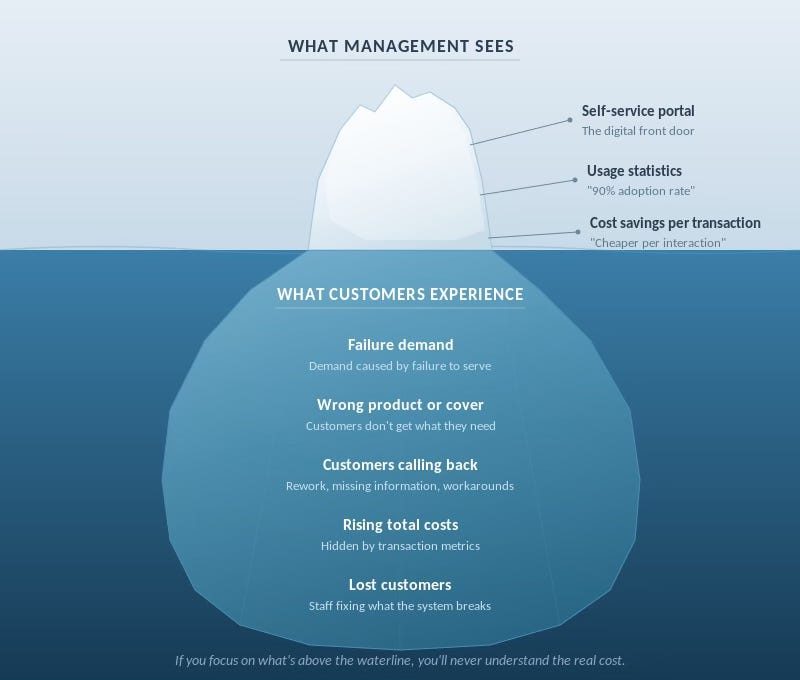
In insurance, those consequences might be bad risk on the books. Or massive volumes of failure demand that nobody connects to the cause. A customer who tried three times to navigate a self-service portal might end up with the wrong product, the wrong billing, or — worst of all — the wrong cover when an accident actually happens. The organisation may never know. The customer certainly will.
In Riv Servicefabrikkerne ned (Tear Down the Service Factories), Kristian and I describe how digital solutions are typically developed starting from what the IT system can do, rather than from what the customer actually needs. The starting point should be what we call the value steps in the process — understanding the customer’s need, gathering relevant information, making a correct assessment, choosing the right solution, and delivering it. Instead, organisations start from the IT system’s capabilities and push the solution out to all customers, assuming that all customers can understand, translate, and correctly input their needs into the system.
The consequences are predictable and devastating. When a local authority studied its digital building permit application, they discovered that around 50% of applications had missing information — exactly the same proportion as the old paper form. The digital solution had simply transferred the problems into a digital format. It was more efficient at collecting information, sure — but the problem was that it didn’t collect the right information. The process, from start to finish, became less effective because it had made things harder for the citizens.
This is the pattern we see again and again. Professor Søren Lauesen from the IT University of Copenhagen, after analysing several large Danish public digitalisation projects, identified the common causes of failure: they don’t identify the user’s needs, they don’t describe requirements that cover the customer’s needs, they bite off more than they can chew, they design the user interface too late, and they’re surprised when different systems need to integrate.
The danger: using AI to do the wrong things faster
Here’s what worries me about the current AI excitement.
AI is extraordinarily good at doing things fast. It can automate processes, generate code, handle customer queries, produce reports, and optimise workflows at a speed that would have seemed like science fiction five years ago. And organisations will use it for exactly that. They’ll cut cost in the short run. They’ll celebrate the efficiency gains.
But if you use AI to automate a broken process, you just get a faster broken process.
If your self-service portal is generating failure demand because it doesn’t help customers express what they actually need — adding an AI chatbot to the portal doesn’t fix the problem. It just helps more people get to the wrong outcome faster. If your complaint-handling process exists because customers routinely get the wrong product, using AI to speed up complaint handling is treating the symptom, not the disease.
“There is a fundamental difference between doing the wrong thing righter and doing the right thing.”
— Russell Ackoff
In our book, we describe how the service factory’s digital focus is primarily driven by one assumption: that digitalisation reduces transaction costs. The organisation assumes it’s cheaper if customers contact them through digital channels, so they do everything they can to push customers that way. Management sees digital solutions as ideal because they advance the dream of full standardisation, centralisation, and automated case handling. Imagine how cheap it would be if you automated everything and didn’t need human involvement at all?
The problem is that this perspective ignores variation. It ignores the fact that customers are different, that their needs vary, and that a standardised digital solution simply cannot handle this variety. The result? Lower transaction costs per interaction — but more interactions, more failure demand, more rework, and higher total costs.
AI, with its extraordinary speed and capability, is about to supercharge this dynamic. Unless we’re thoughtful about how we use it.
The thinking is the problem
Here’s what sits beneath all of this — something that goes deeper than any technology choice.
The way leaders think about how to design and manage work determines the performance of the system. And in most organisations, that thinking starts from a focus on costs: reduce transaction costs, automate to save headcount, push customers to cheaper channels. It feels rational. It feels responsible.
But there’s a paradox that we see play out again and again: when you focus on costs, costs go up. The transaction cost per digital interaction may drop, but the total number of transactions increases because the digital solution doesn’t actually solve customers’ problems. Failure demand floods in. Rework multiplies. The IT department grows to maintain and patch the system. You fire case handlers and hire developers. The total cost goes up, not down — and the service gets worse.
When you focus on value — on truly understanding and delivering what the customer needs — costs come down as a natural consequence. There’s less failure demand, less rework, fewer transactions, less waste. You don’t need to manage costs down because the system is simply doing less unnecessary work.
This isn’t just a digitalisation issue. It’s a leadership thinking issue. And it’s the reason why AI, powerful as it is, won’t save your organisation on its own. If the prevailing thinking is “use AI to reduce costs,” you’ll get the same results you got from every other cost-focused initiative: short-term savings, long-term dysfunction. If the thinking is “use AI to help us deliver better value to customers,” you’re starting from a completely different place — and the results will be completely different too.
The real opportunity: putting knowledge and technology together
So here’s the point I actually want to make.
Today, for the first time, we can put the people who understand the real problem — the frontline workers, the people who know what customers actually need — together with AI-powered technical capability to create and test solutions in hours instead of years.
This is genuinely new.
Previously, when a frontline team discovered through studying their system that customers needed a fundamentally different digital solution, the idea would often die in a backlog. The IT department had a two-year queue. The specification process alone took months. The budget had to be approved. A vendor had to be selected. By the time anything was built, the original insight had been diluted through so many layers of translation that the solution barely resembled what was needed.
Today, someone who understands the problem — someone who has studied the demand, who has followed work end-to-end, who knows what the value work actually is — can sit down with AI and build a working prototype. Sometimes without writing a single line of code themselves. I know this because I did it.
The tool I built last week wasn’t a toy. It was a functional demand-gathering tool that a team can use to study what’s coming into their system — to understand the nature of demand, to distinguish value demand from failure demand, and to see patterns that would otherwise remain invisible. Previously, building something like this would have required weeks of development time, specification documents, and IT department involvement. Instead, it took me and an AI less than two days.
This changes the economics of experimentation entirely. Ideas that would previously have been shut down because of capacity constraints, technical complexity, or knowledge scarcity in IT can now be prototyped and tested quickly. The barrier between “understanding the problem” and “building a solution” has never been lower.
But only if you start from the right place
The opportunity isn’t “use AI to build things faster.” The opportunity is: understand what the real problem is, and then use AI to help you solve it faster.
The sequence matters enormously.
“It is not enough to do your best; you must know what to do, and then do your best.”
— W. Edwards Deming
That’s the heart of this. AI helps you do your best at extraordinary speed. But it can’t tell you what to do. That requires understanding.
And here’s something worth acknowledging: sometimes, when you study your system from the customer’s perspective, you’ll find that the biggest opportunities aren’t about AI at all. Maybe the real problem is a policy that creates unnecessary work. Maybe it’s a handoff between departments where information gets lost. Maybe the digital solution is fine, but the process around it is broken. Not every system improvement needs AI — and being honest about that is part of doing this well. The organisations that will benefit most from AI are the ones that understand where it fits and where it doesn’t.
Before you let AI anywhere near a solution, you need to understand your system from the customer’s perspective. You need to know: What matters to customers? What is the real demand? How much of that demand is failure demand — demand caused by a failure to do something or do something right for the customer? What are the value-creating work steps, and how well are we performing them?
When you have that knowledge, AI becomes a remarkably powerful ally. Not because it can automate everything, but because it can help you build, test, and iterate solutions that are designed around what actually matters.
Here’s what not to do: use AI to optimise error handling, speed up complaints processing, or get customers to do what you want them to do.
Here’s what to do instead: understand the causes of waste and failure demand. Ask what that tells you about what matters to customers and how that relates to your core purpose. Then be curious about what a better system could look like — and how you’d measure whether it’s actually performing better. Then ask how AI can help you improve your organisation’s ability to solve the right problem.
A simple exercise you can try this week
If this has sparked your curiosity, here’s something concrete you can do:
Pick one digital process in your organisation — an application form, a self-service portal, an automated workflow. Then ask these questions:
- What is the purpose of this process from the customer’s perspective? Not from the organisation’s perspective. From the customer’s. What do they actually need?
- What happens when customers interact with it? Follow a handful of real cases end-to-end. Not the data. The actual cases. What really happened?
- How often does the customer get what they need, right first time? Not how often the form is submitted. How often the customer’s actual problem is solved.
- What proportion of the demand on your organisation is caused by a failure to do something or do something right for the customer? This is failure demand. In most organisations we work with, it’s surprisingly high.
- What role does the digital solution play in creating or preventing that failure demand?
The answers might surprise you. And they’ll give you a much better starting point for thinking about where AI can genuinely help — and where it would just make things worse, faster.
If you’re curious about this way of thinking — about understanding organisations as systems, about digitalisation from the outside in, or about how AI and systems thinking work together — I’d love to hear from you. You can reach me at jonas@vanguard-consult.dk or connect with me on LinkedIn.
If you want to go deeper, my book “Riv Servicefabrikkerne ned” (co-authored with Kristian Astrup Nielsen) covers the full method — how to study and redesign systems, understand demand, and build organisations that work for customers. The book is in Danish, but if you send me your email, I’ll send you an executive summary in English (or whatever language you prefer).
This article was written with AI assistance — which felt fitting, given the subject matter.